martes, 13 de diciembre de 2011

How to Craft a Smart Startup Exit Strategy


Jason Lemkin is vice president of web business services at Adobe and former CEO of EchoSign. His operational experience spans the business development, sales, legal, human resource and finance fields, and he is an acknowledged expert in the field of electronic signature and electronic contracting.

Entrepreneurs often speak of their startups as if they were beloved children. The infant business must be protected, nurtured and loved. Its owner must be willing to feed it late at night, to fend off hurtful strangers, to sacrifice in multiple, unexpected ways. And often, those business owners must find a way to let go.

As businesses grow, they do not exactly move out, go to college and get married. However, digital startup entrepreneurs have similar goals for their businesses. "Exit strategies" don't mean entrepreneurs plan to get up and walk away from their businesses without looking back. Rather, entrepreneurs want to raise their startups, prepare them for bigger and better things and let them go, either through acquisitions, public offerings or organic growth. Our businesses can't stay babies forever.

So how does one craft a useful exit strategy for a digital startup? Start with these three elements.

Exit Strategy Do's

  • Broad presence: For a digital startup to make it past the embryonic stage, it must have mass appeal. Can your service be sold to any industry? Is it accessible to buyers large and small? Does it solve a fundamental problem to which most everyone can relate?
  • A committed team: Finding a dedicated group of people to install at the core of your business is critical to a successful exit. Revolving doors don't yield results during the impressionable startup stage. You need the best people, and you need them to stay devoted to rearing your business.
  • Market need: The web business is growing faster than ever before, thus creating huge opportunities for digital startups. Entrepreneurs who can identify consumer needs in this growing market will see successful exits.

Exit Strategy Don'ts

With any three "do's," you'll encounter three "don'ts." Here are three common mistakes that prevent business happy endings.

  • Uncertainty about your business model or ultimate goal: You must know where you're going if you want people to follow you. Although your business model will evolve as will your exit strategy, you have to at least start with a viable plan. Investors, partners, customers and employees will look to you to define the end game, so do it early. Then, keep your eye on the market and adjust as your business matures.
  • Going niche: Narrowly focused digital startups set out on a difficult path with an uncertain destination. The best digital plays are broadly directed, since web apps require wide user bases to breed profitability. Once you identify that expansive prospect group, make sure the idea you offer is fresh. Your idea should add value to an existing market or create a new market that has potential to grow. Copying someone else's plan, no matter how good it may be, is a mistake, especially in a niche market. But tweaking a good idea with broad appeal can lead to a positive exit.
  • Misusing the freemium model: Digital startups love freemium. Entrepreneurs want people to experience their products, so they oftentimes give them away. That's fine, as long as all those freebies result in upgrades. For a company to survive, it has to illustrate in its freemium model all the reasons why users should open their wallets for pro and enterprise versions. After all, a business requires paying customers to succeed, so a good freemium plan must appeal to a broad user base pair with a separate sales strategy that effectively converts users.

One more tip for the doting entrepreneur looking to shepherd his or her digital startup into the world: Iterate. If your first business model turns out to be misguided? Learn. Adapt. Try again. If the market you thought would go crazy for your service remains apathetic? Research. Revise. Re-release. Failures are learning opportunities. They're difficult, painful learning opportunities, but they're ultimately valuable ones.

Whether you define the successful exit for your web app as an acquisition, an IPO or a mature, private company, getting there is easier when you stay focused on the goal without being rigid in its pursuit.

Image courtesy of Flickr, Jer Kunz

Read more >>

Microsoft Brings iPad Support to OneNote


Microsoft just updated its OneNote iOS app to support the iPad. The new version, OneNote 1.3, works on any device running iOS 4.3 or later, including the iPad and iPad 2.

Far from being just adding device support, the iPad version of OneNote makes full use of the tablet's larger screen, with larger pages that can better accommodate things like maps, a menu sidebar, and other iPad-specific features.

Besides iPad support, OneNote 1.3 adds more languages, a tabbed user interface, table rendering and — for those worried about data charges — the option to sync notes only over Wi-Fi.

OneNote is Microsoft's supercharged note-taking app. It was first offered with Microsoft Office in 2003, and was first ported to the iPhone in January this year. It's part of Microsoft's Office suite of products, though it's the only Office app available on iOS… so far. OneNote uses Microsoft's cloud service, SkyDrive, to automatically sync notes across devices.

Curious to see the app in action, I tried out OneNote 1.3 for iPhone. My notes synced with my online Windows Live account within seconds after edits were made — this cloud stuff really works. The interface is a little redundant and counterintuitive at times, though. Microsoft should take a few cues from the better To-Do list makers, like Errands.

Although the iPhone and iPad apps are free, you're limited to just 500 notes. For unlimited notes, you must pay per device, costing $4.99 for an iPhone or iPod Touch, and $14.99 for the iPad. If you have more than 500 notes on SkyDrive, you can still view them on your iOS devices with the free app, Microsoft says, but you won't be able to edit them or create new ones.

Is Microsoft's expanded OneNote support a move toward bringing more Office apps to iOS? Stay tuned.

OneNote-ToDo
Read more >>

El estudio "Las Redes Sociales en Internet" desvela nuevos datos para las empresas


El estudio "Las Redes Sociales en Internet", recién publicado por el Observatorio Nacional de las Telecomunicaciones y la Sociedad de la Información (ONTSI) ha dejado sorpresas y nuevos datos muy útiles para el mundo empresarial.

El objetivo era "conocer en profundidad el comportamiento de los usuarios en las redes sociales" y "esclarecer aspectos de la estructura y funcionamiento de las redes de los usuarios". Y lo ha conseguido pues hay datos novedosos.

Uno de ellos ha sido que el 38,8% de los usuarios españoles utilizan las redes sociales profesionales, principalmente para buscar empleo, publicitarse como profesional y darse a conocer entre los profesionales de su sector.

Otras novedad ha sido la de que el 46,8% de los entrevistados en el estudio, afirman leer opiniones en la red sobre un producto antes de comprarlo. Y sobre todo los menores de 25 años que afirman  dejarse influir y mucho a la hora de comprar por esas opiniones.

Y es que el 55% de los usuarios miran otras webs como foros y redes sociales  relacionadas que no son las de la marca de producto a la hora de decidir la compra. Y nada mas y nada menos que un 82% confía algo, bastante o mucho  en las opiniones de los usuarios de redes sociales sobre un producto determinado o un servicio. Aunque siguen creyendo que la mejor orientación se obtiene en los foros.

El estudio hace además un desglose del tipo de consumidores en la red clasificándolo en tipos como: solicitantes de ofertas, cautelosos, los que creen sólo a los de su círculo de confianza, los amplificadores, que les gusta mostrar sus gustos y opiniones,  los entusiastas, que buscan gente con sus mismos gustos…  y muchos más.

Sorprendentemente en torno al 58%  de los usuarios ni les gusta ni les disgusta la publicidad en las redes sociales, frente a un 22% que les disgusta y un 21%  que les gusta.

Y otro dato de interés entre muchos más que refleja el estudio, basándose en este caso en el "Social Recruiting Survey 2011", es que el 80% de los empresarios o empleados de recursos humanos usan las redes sociales como red aunque sea secundaria para encontrar futuros trabajadores, afirmando invertir un 50% más de recursos de tiempo y dinero en este mercado de búsqueda aún secundario pero en auge.

Por último destacar el continuo aumento del uso de Community Managers para: escuchar que dice la red sobre nuestra empresa, explicar la posición de la misma, buscar talentos y encontrar vías de colaboración.

Un estudio interesante en definitiva que aporta nuevos datos clave para las empresas y los  negocios en la red en muchos sentidos.


Original Page: http://www.ojointernet.com/noticias/el-estudio-las-redes-sociales-en-internet-desvela-nuevos-datos-para-las-empresas/


Read more >>

lunes, 12 de diciembre de 2011

Los museos españoles no entienden las redes sociales


Los museos españoles no entienden las redes sociales

El modelo de gestión de los museos y centros de arte españoles, nacidos la mayoría con el respaldo económico de las administraciones, está en crisis y tienen un futuro incierto. En los últimos meses, muchos centros de arte programan exposiciones de forma conjunta, o incluso fusionan sus colecciones con la idea de unir esfuerzos y reducir costes. Pero en realidad, la mayoría de museos y centros de arte españoles demuestran tener poco interés por la actividad y la programación que realizan sus colegas y trabajan de espaldas unos a otros. Es una de las conclusiones del estudio Análisis de las conexiones de museos y centros de arte en la redes sociales publicado por el portal cultural Dosdoce, tras analizar cómo utilizaron 50 museos españoles las redes sociales, sobre todo Facebook y Twitter.

Se aconseja que los comentarios en las redes no parezcan "un corta y pega" de la información de la web oficial

Tras comprobar que la presencia en las redes sociales de los museos es una realidad aplastante (en 2007 la presencia era mínima) y que los equipos directivos y responsables de comunicación son cada vez más conscientes de su poder, el equipo dirigido por Javier Celaya ha constatado el poco uso que los museos españoles hacen de las web 2.0. "No tienen claro la estrategia ni lo que pretenden conseguir con ellas y sólo lo hacen por estar". Según el estudio, pocos centros explotan adecuadamente los activos de comunicación que representan las redes y la mayoría pecan de "corporativismo" tanto por el tono como por el contenido. Por eso aconseja a los equipos de comunicación hacer un esfuerzo porque sus comentarios en las redes no parezcan "un corta y pega" de la información ya publicada en la web oficial de la entidad.

Para Celaya, los museos y centros de arte, "cuya actividad representa el 4% del PIB español, actúan como pequeñas islas en el mundo cultural". Según el informe, los museos mantienen poca interacción con sus fans y seguidores online, uno de los fundamentos de la red social, no preguntan cuáles son sus intereses y qué esperan, y en el caso de que los seguidores hagan preguntas u observaciones no reciben respuestas, en la mayoría de los casos. "Una de las cosas que más sorprende es ver que los museos no siguen a sus seguidores. Así es imposible saber qué es lo que esperan", explica Celaya.

Amigos en la Red

Ente los centros que más amigos tienen en la red, tanto en Facebook como en Twitter, destacan el Reina Sofía, La Casa Encendida y Caixaforum, los tres en Madrid, seguidos del Museo Picasso y el Centro de Cultura Contemporánea, en Barcelona. En Facebook, repiten el Reina Sofía, como el centro con mayor interactividad con sus seguidores, y el Museo Picasso de Málaga como el museo que sigue a más museos, 40 en total; mientras que en Twitter, ocupa la primera posición el Centro de Cultura Contemporánea, CCCB, que además es el que cuenta con más menciones y retweets en la red. En la cola de Facebook se sitúan tres centros barceloneses: el Centre d'Art Santa Mònica, CaixaFòrum de Barcelona y la Fundación Antoni Tapies, que durante el periodo de estudio, mayo de 2011, no generaron ninguna actividad en esta red social. En el caso de Twitter dos de los centros que no generaron actividad fueron la Fundación Joan Miró de Barcelona y el Espacio de Arte contemporáneo de Castellón.

Los responsables del informe han realizado un mapeo situando las conexiones y los flujos de información, el número de post escritos en un día, los eventos creados, la emisión de comentarios, así como los tweets diarios en los centros durante el periodo analizado. Madrid aparece como la ciudad con una mayor actividad en el caso de Facebook, mientras que en la caso de Twitter, hay un equilibrio entre la capital española y Barcelona. Esto se debe, según Celaya, al hecho de que se ha comprobado que los centros madrileños "utilizan las redes como una herramienta de divulgación, ocio y entretenimiento, mientras que los barceloneses lo hacen como búsqueda de información". En todo caso "ni unos ni otros presentan una estrategia y su presencia en las redes se debe al efecto que yo describo a mis alumnos como de 'Escuela Loreal': porque yo lo valgo", concluye.

Fuente:http://www.elpais.com/articulo/cultura/museos/espanoles/entienden/redes/sociales/elpepucul/20111208elpepucul_2/Tes

Read more >>

El 97% de los ingresos de Google provienen de la publicidad [infografía]


GoogleBusinessMBA.org ha publicado una infografía que recoje toda la información disponible del gigante de las búsquedas a nivel empresarial. Algunos de las mareantes cifras que esta empresa mueve son verdaderamente increíbles, y descata que a pesar de todos los esfuerzos de Google por diversificar su oferta de productos, hay uno que sigue siendo su principal negocio: el 97% de los ingresos provienen de la publicidad.

Estas son algunas cifras, y tras el salto podréis ver los datos recogidos en una interesante infografía:

  • La publicidad móvil aporta 2.500 millones de dólares a los ingresos de Google y cuando cierre el ejercicio 2011, esta cantidad se duplicará.
  • Las palabras más caras de Google AdWords siguen siendo los seguros, los préstamos, las hipotecas, los abogados y los créditos.
  • Google recibe mil millones de visitantes únicos cada mes.
  • El consumo enérgetico de Google es brutal. En 2010, Google consumió más de 2.000 millones de kilowatios de energía.
  • Google ingresó 29.300 millones de dólares en 2010. Una cantidad superior a la suma del PIB de los 28 países más pobres del mundo.

infografia google

Original Page: http://www.ojointernet.com/noticias/el-97-de-los-ingresos-de-google-provienen-de-la-publicidad-infografia/


Read more >>

GAIN Fitness Raises $650K From YouTube & Google Angels For Personal Training 2.0

GAIN Fitness Raises $650K From YouTube & Google Angels For Personal Training 2.0

103783v4-max-250x250

GAIN Fitness, a startup that creates personalized workouts based on certified trainers' expertise, announced today that it has raised $650K in seed funding from InterWest Partners, Slide COO and angel investor Keith Rabois, Former Director of Platform at Facebook and Director of Partnerships, Content and Platforms at YouTube, Ben Ling, Michael Tanne, early founding YouTube team member Brent Hurley, Seraph Group and others.

This comes on top of GAIN's launch of its iPhone app in July, which allowed fitness enthusiasts to begin accessing their personalized routines via mobile. Founded by former Googlers, GAIN is all about allowing those looking to get in shape access to quality training regimens without having to pay for expensive personal trainers or go through the process of researching workouts by creating a symbiotic marketplace for both personal trainers and fitness consumers.

GAIN's iOS and web apps currently deliver these personalized workout experiences that can be experienced on the go, but the startup (backed by its new infusion of capital), aims to launch v3.0 of its iOS in January, which will supe up the platform, allowing its professional trainers to design and sell fitness multimedia "packs" that target specific fitness goals, usage scenarios — like at the gym, on the road, or at home, as well as different fitness levels.

This update will be a big lunge forward for GAIN as a GAIN, as it will give users of all stripes, body types, fitness levels — in any scenario — the opportunity to design personalized workout routines, or maintain their plans, from any location, regardless of schedule.

Those with demanding jobs, schedules, and full travel schedules are all too aware of the cost these things can have on staying in shape. The key for success for a young startup (aside from funding, etc.) is listening to feedback from your users, even if taking their feedback to heart means "pivoting" or adapting your service to meet their needs. In the case of GAIN, Founder and CEO Nick Gammell said that, initially, the teams' focus was solely on the Web.

From the beginning, they've wanted to become an "anytime, anywhere" fitness resource, but the Web continues to be the venue of choice for more complex schedule, discovery, and social tools. But the startup's 600K+ users wanted to be able to access their fitness routines on the go, and so GAIN, which had building an iOS app on the side, launched a paid app. But users weren't happy about the pay grade, so they relaunched the app for free.

Since then, he says, users have been using GAIN's workout building and tracking tools 4 to 5 times more, per user, compared to its web app. Now, Gammell said, the service is at a place where 40 percent of sessions are happening via mobile device, a bulk of which has come since the free app launched in October. In case you needed another example of how free beats the paywall, it seems GAIN is it.

GAIN also happens to look great, which is easy when you have the original designer of Google-acquired Picasa and NASA app developers on your team. With more than 700-plus exercises (strength, plyometric, callisthenic, yoga), as well as custom-tailored workouts, the startup is attempting to democratize the fitness experience, and so far it seems to be working. It will have to considering the plethora of gamified fitness startups out there, like Fitocracy, or any number of other cool startups, like Fitango, CrossFit, Fitbit, RunKeeper, WellnessFX — not to mention wellness devices.

It's wonderful to see, because we, as a country need to stay in better shape.

The startup plans to announce its trainer partners, along with its new iOS marketplace in January 2012, and Gammell says that an Android app is on its way.


Original Page: http://feedproxy.google.com/~r/Techcrunch/~3/4YyejcJRkqw/

Read more >>

Can Facebook Get You a Job? [INFOGRAPHIC]

Can Facebook Get You a Job? [INFOGRAPHIC]

In answer to the question above, approximately 18,400,000 Americans say yes, they got their current job through Facebook. Though Zuck's platform ranks #1, Twitter and LinkedIn don't have shabby numbers either — 8 million and 10.2 million Americans, respectively, have gotten their jobs through social platforms.

Judging from our Job Search Series, it should come as no surprise that being socially savvy pays off in the job hunt for two reasons — it helps you network, and it's a highly marketable strength in your skill set, given all the openings in the digital space. So, it's about time you spruce up those social profiles and start networking.

The infographic below combines data from Jobvite, CNN, LinkedIn and JobSearch to assemble a statistical picture of the modern-day job seeker. Check it out for interesting insights and some tricks of the trade to help you land a job


Infographic courtesy of MBA Online

Read more >>

viernes, 2 de diciembre de 2011

5 Big Reasons CEOs Should Get Social [INFOGRAPHIC]


Over the past few months, we've introduced you to some of the most impressive CEOs in the digital marketing and tech space. While the businesses have flourished online, so too have the social profiles of the CEOs — they realize the power of Twitter, Facebook and other social platforms, and they use them regularly.

In case you missed it, here's a recap of the five posts in our Social CEO Series. Below that, you'll find an infographic that highlights data about how some in the C-suite are using social media sites, how they consume news and the benefits of being a socially savvy CEO.


1. Why Richard Branson Always Makes Time for Social Media


Where most corporate blogs still house formal announcements, the Virgin Group website hosts a blog written with Branson's first-person flair. Many of them read like diary entries.

Branson's Twitter, Facebook and Google+ profiles are all equally personal and active. Much of what he posts is related to his many philanthropic efforts. But other times, he's just tweeting his thoughts or writing about his active globe-trotting lifestyle. Here, he explains why he puts in the effort. Read the full story here.


2. Why Evernote Bet the Company on Mobile & Social Media


At the helm of Evernote, an emerging digital note-taking empire, is the personal-memory-assistant-obsessed Phil Libin. As a blogger, active Tweeter and Google+ neophyte, Libin is the quintessential social CEO, and he bet the success of his company on mobile and social media before it was cool to do so. Read the full story here.


3. How Jetsetter's CEO Keeps the Travel Conversation Flowing With Social Media


Drew Patterson is the CEO of Jetsetter, a two-year-old travel startup and member of the Gilt Groupe luxury flash deal family. The site offers 20 to 40 sales each week on "Jetsetter-verified" hotels, villas and adventures all around the world to its two million members. The site uses social media to maintain a dialogue about travel with consumers about travel. Everything from dream destinations and honeymoon planning to customer service and feedback is filtered through social media. Read the full story here.


4. How Kiva.org's CEO Uses Social Media to Spark a Dialogue of Change


What does it mean to lead a non-profit in the social media age? For Matt Flannery, the CEO of micro-lending network Kiva.org, it's about maintaining personal connections with thought leaders and engaging in constructive dialogue with his organization's supporters.

The site, founded in 2005, has grown up with social media and matured with the platforms that are now so active in driving awareness to causes and campaigns. After lending more than $241 million to entrepreneurs in developing countries, we can't help but wonder if the worlds of micro-finance and micro-communication have somehow become intertwined. Read the full story here.


5. How Social Media Helped Kate Spade Become a Global Brand


If our play-by-play coverage is any testament, Kate Spade New York ranks among the strongest brands in the online marketing space. From Twitter and Tumblr to Instagram and online video, the quality and strength of voice the fashion and lifestyle label has brought to each new platform is consistently impressive.

We spoke with Craig Leavitt, who joined Kate Spade in 2008, about the fashion company's gains in digital media and ecommerce, the latter of which is approaching triple-digit growth this year. Read the full story here.


The Social CEO


Infographic courtesy of Voltier Digital, based on research from CEO.com

Original Page: http://feeds.mashable.com/~r/Mashable/~3/oR3khzNrNWM/


Read more >>

Google: de gigante de las búsquedas ¿a gigante del comercio electrónico?

La compañía ha iniciado negociaciones con varios minoristas para crear un servicio de envío rápido de productos, tras comparar las mejores ofertas en Google Product Search.

A Google no le basta con ser el gigante de las búsquedas. Ahora apunta directamente al mercado dominado por Amazon para robarle un pedazo de la tarta del comercio electrónico.

Además de con el buscados de productos, el nuevo servicio podría combinarse con el sistema de pago Google Wallet y la red social Google+.

Además de con el buscador de productos, el nuevo servicio podría combinarse con el sistema de pago Google Wallet y la red social Google+

Para ello, ya ha iniciado negociaciones con minoristas de la talla de Macy's, Gap y OfficeMax. De llegar a buen puerto, su asociación le permitirá ofrecer a los usuarios de Internet un servicio de envío rápido de productos, justo después de haberlos localizado a través de su buscador.

¿Cuán rápido? En sólo 24 horas tras la solicitud de compra, lo que recuerda a Amazon Prime que por 79 dólares al año agiliza las distribuciones de paquetes, entre otros beneficios. Aunque en este último caso puede tardar hasta dos días.

Según informa The Wall Street Journal, el proyecto de Google se diferenciará por integrarse con Google Product Search, que ya permite encontrar determinados productos en la red y compararlos a través de diferentes sitios de e-commerce hasta obtener la mejor oferta. Será entonces cuando se ofrecerá al cliente la posibilidad de recibir su compra en casa en sólo un día.

Lo que no está claro es cuánto se cargará por utilizar este servicio de envío rápido. Se habla de una "tarifa baja" y de que Google iniciará una primera fase piloto en San Francisco en algún momento de 2012.

 
Read more >>

7 Hot Trends in Mobile App Design

.The mobile application space is exploding. Users increasingly turn to smartphones and tablets to consume and create content, whether on the go or on the couch. The iOS App Store and the Android Market both have app collections in the hundreds of thousands.

Like web or desktop apps, mobile application design is often trend-driven. As mobile platforms have evolved over the last few years, some of the common design practices of the past have ceded to new styles and techniques.

We've scoured the App Store and Android Market to highlight seven of the hottest trends in mobile app design.


1. The "Instagram" Effect


In the words (we think) of Pablo Picasso, "good artists borrow, great artists steal." That adage is true for most creative endeavors and it can certainly be applied to the mobile phone space.

In the past few years, we've seen apps like Facebook for iPhone and Twitter (new Tweetie) influence the direction and UX paradigms in mobile applications. Loren Brichter introduced the pull-to-refresh gesture in the first version of Tweetie for iPhone back in 2008, and the technique has since become so commonplace, it has been adopted on multiple app platforms and applications.

Instagram is already proving itself to be the Tweetie or Facebook of 2011. Photo sharing apps are exploding right now, and Instagram is leading the pack in terms of features and user interface.

Need proof? Check out the recently redesigned Picplz for iPhone. The navigational structure of the app has been augmented to mirror Instagram in terms of functionality (which is great, because that makes it easy to use both apps). Likewise, the app now handles filters in a similar way.

We fully expect to see photo apps adopt Instagram's navigational structure, feed browsing display and instant effects preview well into 2011.


2. Bold, Primary Colors and Gradients With Minimal Gloss


Color is becoming an increasingly popular way for developers to make their apps stand out from the competition.

The first wave of apps created for touchscreen devices often mimicked Apple's native iOS applications. This makes sense. After all, those components are included within Xcode's Interface Builder.

What we're seeing more of, however, is a move away from the iPhone blue and gradient stripe background and a shift to bolder primary colors and gradients. The glossy button look popularized by the Web 2.0 era has been eclipsed by more matte finishes.

Having strong colors in an application can create emotive responses from users, sometimes deeming an app more memorable. If a user remembers an application, he just might pick it up again.


3. Retro Photo Viewfinders


Apps like Hipstamatic and 8mm Vintage Camera [iTunes link] are a great example of how modern technology can be retrofitted to the past.

The real-time video effects within 8mm help create the experience of using an old analog movie camera to capture video. Likewise, the smaller lens window in Hipstamatic — which obscures the full capture area, just like on a real toy camera — is a dead ringer for using an old Holga.

Apps like Instagram and Picplz have shown that applying filters is a great way to make sharing photos more fun. The apps that apply filters in real time, as an image or video is being captured, usually invoke more retro-realist design choices.


4. Texture, Texture, Texture


Along with the trend of bolder primary colors, app developers are also shifting to using textures and patterns in their application backgrounds.

Wood panels are a popular choice and semi-transparent menu items often look great on these types of backdrops. Some apps, like Jamie's Recipes use textures in the overlapping elements as well.

Texture-driven app designs often use inset text and various levels of transparency.

Texture can add a tremendous amount of personality to an application, but developers should be mindful of how text and button elements look on top of the background. The wrong color choice can make content unreadable or buttons hard to find.

GO Launcher for Android is a good example of how a textured background and shelf paradigm can be applied to the standard Android homescreen.


5. Smooth, Clean Gradients and Shadows for Depth


Some of the trends in mobile app design can be directly traced to the same trends in web design. A big trend in web design is a move towards clean, minimalistic designs.

We're seeing this in mobile apps as well, particularly with menu and navigational headings. Rather than using the standard iOS or Android menu paradigm, developers are creating their own layouts that, while still appropriate for a finger, look more elegant.

Using shadows to create the perception of depth can give these buttons and interface elements a more "touchable" look and feel, while also appearing more striking.

These shadows can work particularly well in apps that don't have a simple list view interface. For instance, in the XfinityTV app, the left channel bar can move independently from the main programming section. Rather than just use a grid, Xfinity added shadows to clearly designate both sections. The user can instantly sense that the elements are separate and can be controlled independently.


6. Text Driven Interfaces


We can credit Microsoft and its Windows Phone 7 for making text a mobile design trend.

The earliest mobile apps, of course, were largely text based because text loads quickly over a slow connection and doesn't require an advanced rendering engine.

Modern mobile apps don't need to rely on text but as Microsoft has shown us, when used appropriately, text-driven interfaces can be highly usable and great on the eyes.

The best apps that embrace a text-centric approach are those that use text appropriate in context. Text works best when it is large, easy to read and unencumbered by other interface elements.

For example, Weather Quickie is a very sparse weather app that simply tells the weather in the context of current conditions. For instance, "colder than yesterday" or "tomorrow will be warmer than today." By not showing specific temperatures or forecast conditions, the app is easy to read and understand on the go. Icons can add context for conditions like rain or snow.

Likewise, Trickle is a Twitter app that display tweets in a very readable way, one tweet per screen. You can then choose to favorite or retweet that message before scrolling off to the next. By showing only one tweet per page, the app can be used much more passively than traditional Twitter clients.


7. Thin Sans Serif Fonts


As mobile apps evolve, developers are shifting away from the standard app fonts and utilizing more custom weights, styles and sizes. Like shadows and depth contours, many of the design cues for typography in mobile apps come from the web.

Thin sans serif fonts — usually with some level of drop shadow — are increasingly common place in desktop web design.

On mobile devices, the combination of thinner type and high resolution screens often makes for a more readable experience. It also helps differentiate apps. Thin sans serif fonts are often coupled with text-driven designs or with designs that utilize background texture.

Although some apps are including their own custom fonts for logos or header elements, simply changing the weight and size of a font can make the system default (Helvetica Neue on iOS and Droid Sans on Android) appear totally different.

Read more >>

jueves, 1 de diciembre de 2011

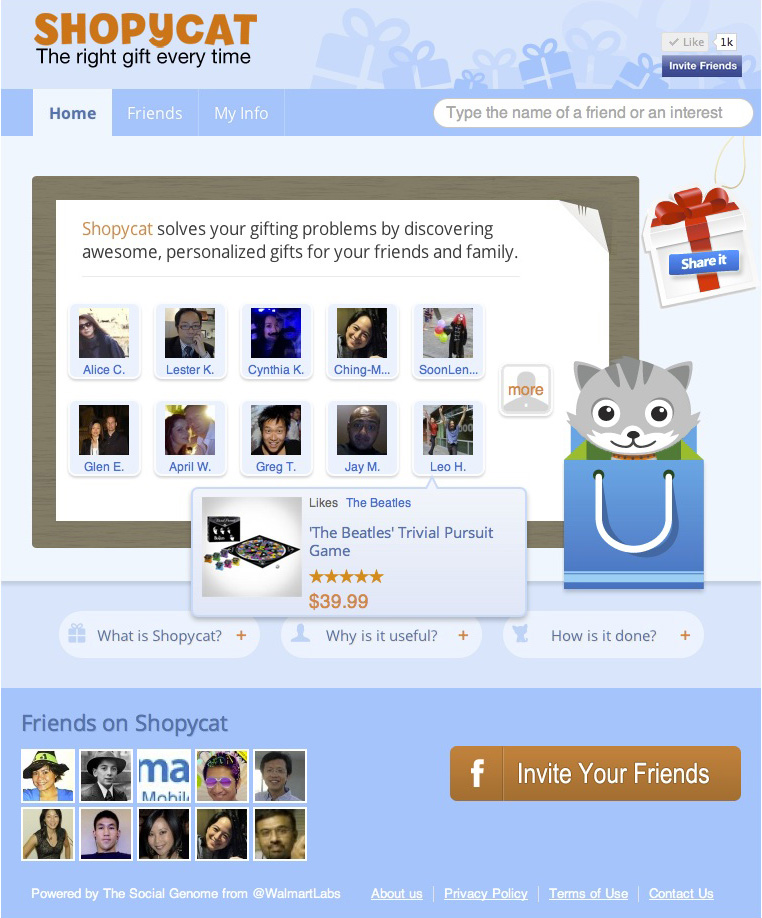
Walmart Launches Shopycat, A Social Gift Finder Built On Top Of Facebook


Shopycat

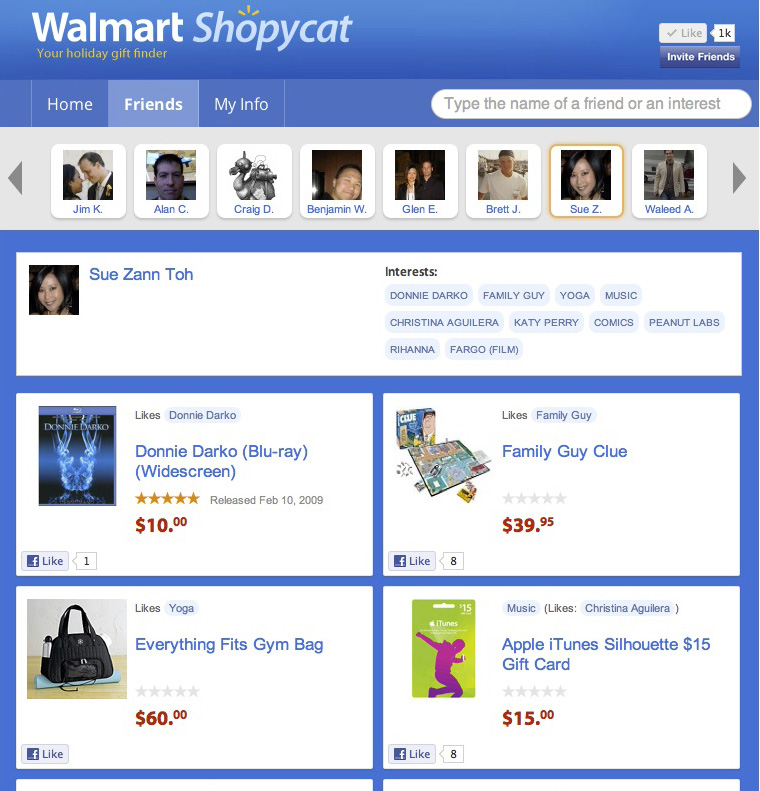
Retailing giant Walmart is launching its first-ever social gifting platform tonight, dubbed "Shopycat." The service, previously in beta, is initially available as a Facebook application where it will also be promoted to the nearly 11 million Facebook users who have "liked"Walmart's fan page. The app, which suggests gifts for friends based on their Facebook use, was built with technology Walmart acquired from social media startup Kosmix (now @WalmartLabs) earlier this year.

And here's the interesting part: the new app won't just point you to pages on Walmart.com for its gift recommendations. It also recommends products from nearly two dozen other retailers, including Barnes & Noble, ThinkGeek, RedEnvelope, NBC Universal, Hot Topic and more. (Just not, of course, Amazon).

The technology behind Walmart's gift recommendations grew out of Kosmix's Social Genome, a semantic technology platform that was originally used to power social media discovery services built primarily on top of Twitter. Now that Kosmix's platform is a part of Walmart, those same algorithms are used to analyze people's interests based on their Facebook posts, profile updates and "likes."

The system is smart enough to understand the sentiment behind a Facebook status update, too, not just the keywords involved. So, for example, if you posted "I hate Twilight!" as a Facebook status update, Shopycat won't recommend that your friends buy you the "Breaking Dawn" Blu-Ray. It also knows what items are more "giftable" than others, using algorithms that examine a number of signals, including recency, uniqueness (e.g., a collector's edition over a standard edition) and the aggregate buying behavior of shoppers on Walmart.com.

While the obvious goal is to encourage traffic and purchases via Walmart's e-commerce website, the company has taken a unique approach by not making it a Walmart-only application. That is, if Walmart doesn't have the perfect gift in stock, either online or at your local store, it will point you to another retailer who does. For starters, this includes a list of around 20 third parties, but the company plans to increase that number next year. This effort also includes gift cards for things like iTunes, Starbucks and Zynga.

These outside recommendations serve as a clever tactic to boost the viral nature of the Facebook app itself (i.e., it's not Walmart only, so it's actually kind of cool). But the design also helps Walmart take on its main online retailer: the virtually infinite online warehouse that is Amazon. Whether Walmart will then use these referrals (to which it receives no affiliate income, we're told ), to later inform its own buying decisions has yet to be determined.

We do know that the company does plan on integrating Facebook Connect within its own e-commerce site at some point in the future, allowing users to authenticate with Facebook to see social recommendations from friends. This, of course, could serve the even more valuable purpose of associating a Facebook user's online identity with their actual transaction data, but whether or not (or to what extent) this will occur is still unknown.

In the nearer future, the plan is to instead bring the Walmart.com online store to Facebook. The app currently shuffles users out of Facebook when it's time to buy, but by mid-2012, Shopycat will function as an online store itself, allowing users to buy from Walmart without every having to leave Facebook.

Walmart isn't the first to use Facebook's social signals to make gift recommendations, of course. The homemade goods outlet Etsy launched its Gift Finder recently, also on top of Facebook data, and eBay's latest acquisition, Hunch, which is known for building a "taste graph" of recommendations by asking questions, released its own Facebook appback in 2010. However, as the world's largest brick-and-mortar retailer, Walmart's foray into social commerce can't be overlooked.

For what it's worth, Amazon has had similar technology in place since July 2010, and had experimented with Facebook apps for social gifting as far back as 2008. But Amazon's focus lately has been more on mobile, with a plethora apps and its Kindle devices, and less on developing its Facebook recommendation technology. Its Facebook-enabled recommendations, in fact, are still listed as being in "beta" on the Amazon homepage. And frankly, their accuracy hasn't improved much since last year's launch. In early tests, Walmart's Shopycat app seemed at least on par with Amazon's recommendations, which is to say, only fair. (Do not buy me Star Wars Jedi Bath Robes, for example.) But Shopycat doesn't let you customize the recommendations beyond "unliking" a Facebook page to adjust the signals the app uses.

Even though technology like this has existed for years, it's still the early days for social e-commerce. Many of the kinks and problems with leveraging Facebook for recommendations, gifting and otherwise, will be overcome in time. To give Shopycat a go for yourself, visit the Facebook app here.

TIMELINE
Read more >>

“Smart Cities”: Orange desarrolla un sistema asequible para poblaciones pequeñas

Orange ha desarrollado una innovadora aplicación en el ámbito de las "Smart Cities" con el objetivo de que las ciudades pequeñas, con menos capacidad económica que las grandes urbes, también puedan mejorar la gestión de sus recursos mediante el uso de la tecnología, logrando un mayor ahorro de energía y reducción del impacto medioambiental.

La compañía está realizando una prueba piloto del sistema en la localidad catalana de Sant Vicenç dels Horts (municipio de 28.000 habitantes y 9 Km2 de extensión) instalando una red de sensores tolerante al retardo mediante el protocolo de comunicaciones ZigBee. Los sensores utilizados han sido diseñados ad-hoc para vigilancia medioambiental, control de la iluminación, ocupación del alcantarillado y disponibilidad de plazas de aparcamiento que trasmiten la información que recopilan, de forma eficaz y asequible, aprovechando el recorrido de las líneas regulares de autobuses.

En los vehículos se instala un nodo que, a su paso, activa el sensor "dormido" que se haya situado en los espacios en los que debe realizarse una medición. Al activarlo, el dispositivo recupera la información y la transmite a un servidor que es el que almacena, analiza y muestra los resultados para que se puedan tomar decisiones sobre datos reales. La información se transmite al centro de control mediante un enlace M2M (Máquina a Máquina ) mediante tarjetas SIM 3G/GPRS.

Este proyecto impulsado por el Departamento de Innovación de Orange se está realizando con la colaboración de la "Fundació Internet i Innovación Digital de Catalunya " i2CAT, la Universidad Politécnica de Cataluña, y la Concejalía de Tecnologías de la Información del Ayuntamiento de Sant Vicenç dels Horts. Después de un periodo de diseño, pruebas de laboratorio y de campo en la vía pública y en la red de alcantarillado, el servicio estará plenamente operativo durante el próximo mes de enero.

La utilidad de este proyecto y su capacidad de llevar también a las ciudades pequeñas el concepto de sostenibilidad, ha hecho que la prueba piloto desarrollada en la localidad catalana haya sido seleccionada para ser presentada en la "Smart City Expo", el primer evento europeo con un enfoque global sobre ciudades inteligentes que se celebrará en Barcelona del 29 de Noviembre al 2 de Diciembre. El concepto de "smart city" define a aquellas ciudades que aplican soluciones innovadoras para garantizar un desarrollo económico y urbano sostenible en un entorno que ofrezca una buena calidad de vida para sus ciudadanos.

http://www.smartcityexpo.com

LOriginal Page: http://www.eleconomista.es/CanalPDA/2011/13068/

Read more >>

How People Look at Your Facebook Profile and others

The study used the webcams of 30 participants to record their eye movements as they were shown profile pages from Facebook, Google+, LinkedIn, Flickr, YouTube, Klout, Reddit, Digg, Tumblr, Twitter, StumbleUpon and Pinterest at 10-second intervals. What participants looked at on each page and in what order is recorded in the images below.

It's not a perfect study. Thirty is a small sample size, and what draws attention on a profile likely varies depending on the content displayed. But we've hazarded making a few observations:

  • Profile pictures matter. The site feature that attracted most attention on Klout, Facebook and StumbleUpon was the profile photo.
  • Job title garnered more attention than profile photo on LinkedIn. In fact, it got more attention than anything else on the page.
  • Who you know gets noticed. Even if for no better reason than their placement on the page, people do look at those little thumbnails of friends that appear on many social profiles. You can see this in the data from the Facebook, Google+, Twitter and Klout profiles.
  • Content on top wins. The further something is down a page, the fewer number of people look at it. This was true on both content-focused profiles such as Pinterest and Digg as well as socially focused profiles such as Facebook. On the Twitter and YouTube profiles, the effect was less extreme.

Original Page: http://mashable.com/2011/11/30/social-profile-eye-tracking/

Read more >>

miércoles, 30 de noviembre de 2011

3 Steps to Mastering Good Blogger Outreach

3 Steps to Mastering Good Blogger Outreach

Awareness is the first step of any customer outreach program. It has to be, and that's why small business owners are always on the hunt for media coverage. You want to get your name out there to let people know who you are, what you do, and why they should give your company a shot. And when we're talking about getting press as an SMB, it's important to remember that we're not just talking about your local newspapers, local television stations or even the local sections of larger news outlets. We're also talking about bloggers – the voices who cover your industry and/or neighborhood online on a regular basis.

If you're not sure why blogger outreach should be part of your marketing strategy, the recent State of the Blogosphere 2011 report released by Technorati (and blogged about by eMarketer) does a good job laying it all out for you.

  • 38 percent of all bloggers post about brands they love or hate.
  • 34 percent of bloggers write product or service reviews.
  • More than 45 percent of bloggers write about the brands that they follow in social media.

If people are talking about you, people with established audiences, isn't that a conversation you at least want to be in on, if not help lead? Many of these numbers are also up dramatically from just last year. For example, last year's Technorati "State of the Blogosphere" reported that 29 percent of bloggers were influenced by other blogs they read. In 2011, that number has risen to 68 percent. As consumers adopt social buying behaviors, researching online and buying off, more and more they're looking toward online reviews to help them make buying decisions and decide where they want to spend their money. And those online reviews are happening not only on sites like Yelp or TripAdvisor, but also on niche blogs.

As a small business owner, what should you be doing to up your blogger outreach efforts? Below are three steps to get you started.

Step 1: Research Your Contacts

Before you can begin any type of blogger outreach campaign, you have to know who you want to reach out to. Create  a press or media list to help you group and organize your contacts. Your press list should include bloggers who have covered your business in the past, have covered competitors, or cover local happenings or news in your particular industry. To help you track down these people, you can use tools like Twellow or Twitter's Advanced search to find bloggers located in your area, Tweepz to search Twitter bios for relevant keywords, Twitter directories like WeFollow, and your social analytics to identify which fans of your brand are tweeting or talking about you naturally. Your press list should be built out to include the blogger's name, the blog URL, their social handles, an email address, the angle they typically cover, etc.

Step 2: Get on Their Radar

Once you have a blogger in your sights, it's time to start a relationship. Just like at a cocktail party, you never want someone's first contact with your brand to be you asking them for a favor or a handout. Make it about them as you lay the groundwork for a  relationship. Get on their radar by starting a conversation on Twitter, helping them promote something they just published, sending them an email to say you're enjoying their content (without pitching yours!) or connecting with them on Facebook. Just do something to get that conversation flowing and help them remember your name. That name recognition is what you're going for to help you go from "stranger" to "friend."

Step 3: Master the "Unpitch"

No one likes to be marketed to, but we all like finding out about great new products or services. As bloggers, we also like being the first to share that information with our audience. When you do reach out to your blogger contacts about covering your company, reviewing your product, or just sharing what you do with their audience, help it sound less like a pitch by highly customizing it to the person you're talking to. An email telling someone about a new product isn't marketing when it's something that is very relevant to them or their audience. Then it becomes a useful heads-up and something we can use. Master the "unpitch" by matching your message directly to the needs of the person you're contacting and showing the benefits of your product instead of trying to sell them. It's OK to ask for a product review or ask to be included in an upcoming post, but make sure you tell them what's in it for them and their audience , not for you.

As social buying patterns continue to grow in influence, consumers will continue to seek out information about others' interactions with brands. And when they do, it's blogs that they'll stumble upon. What are you doing to better connect your brand with the writers providing that information and the people looking for it?

From Small Business Trends

3 Steps to Mastering Good Blogger Outreach

Read more >>