viernes, 2 de diciembre de 2011

Google: de gigante de las búsquedas ¿a gigante del comercio electrónico?

La compañía ha iniciado negociaciones con varios minoristas para crear un servicio de envío rápido de productos, tras comparar las mejores ofertas en Google Product Search.

A Google no le basta con ser el gigante de las búsquedas. Ahora apunta directamente al mercado dominado por Amazon para robarle un pedazo de la tarta del comercio electrónico.

Además de con el buscados de productos, el nuevo servicio podría combinarse con el sistema de pago Google Wallet y la red social Google+.

Además de con el buscador de productos, el nuevo servicio podría combinarse con el sistema de pago Google Wallet y la red social Google+

Para ello, ya ha iniciado negociaciones con minoristas de la talla de Macy's, Gap y OfficeMax. De llegar a buen puerto, su asociación le permitirá ofrecer a los usuarios de Internet un servicio de envío rápido de productos, justo después de haberlos localizado a través de su buscador.

¿Cuán rápido? En sólo 24 horas tras la solicitud de compra, lo que recuerda a Amazon Prime que por 79 dólares al año agiliza las distribuciones de paquetes, entre otros beneficios. Aunque en este último caso puede tardar hasta dos días.

Según informa The Wall Street Journal, el proyecto de Google se diferenciará por integrarse con Google Product Search, que ya permite encontrar determinados productos en la red y compararlos a través de diferentes sitios de e-commerce hasta obtener la mejor oferta. Será entonces cuando se ofrecerá al cliente la posibilidad de recibir su compra en casa en sólo un día.

Lo que no está claro es cuánto se cargará por utilizar este servicio de envío rápido. Se habla de una "tarifa baja" y de que Google iniciará una primera fase piloto en San Francisco en algún momento de 2012.

 
Read more >>

7 Hot Trends in Mobile App Design

.The mobile application space is exploding. Users increasingly turn to smartphones and tablets to consume and create content, whether on the go or on the couch. The iOS App Store and the Android Market both have app collections in the hundreds of thousands.

Like web or desktop apps, mobile application design is often trend-driven. As mobile platforms have evolved over the last few years, some of the common design practices of the past have ceded to new styles and techniques.

We've scoured the App Store and Android Market to highlight seven of the hottest trends in mobile app design.


1. The "Instagram" Effect


In the words (we think) of Pablo Picasso, "good artists borrow, great artists steal." That adage is true for most creative endeavors and it can certainly be applied to the mobile phone space.

In the past few years, we've seen apps like Facebook for iPhone and Twitter (new Tweetie) influence the direction and UX paradigms in mobile applications. Loren Brichter introduced the pull-to-refresh gesture in the first version of Tweetie for iPhone back in 2008, and the technique has since become so commonplace, it has been adopted on multiple app platforms and applications.

Instagram is already proving itself to be the Tweetie or Facebook of 2011. Photo sharing apps are exploding right now, and Instagram is leading the pack in terms of features and user interface.

Need proof? Check out the recently redesigned Picplz for iPhone. The navigational structure of the app has been augmented to mirror Instagram in terms of functionality (which is great, because that makes it easy to use both apps). Likewise, the app now handles filters in a similar way.

We fully expect to see photo apps adopt Instagram's navigational structure, feed browsing display and instant effects preview well into 2011.


2. Bold, Primary Colors and Gradients With Minimal Gloss


Color is becoming an increasingly popular way for developers to make their apps stand out from the competition.

The first wave of apps created for touchscreen devices often mimicked Apple's native iOS applications. This makes sense. After all, those components are included within Xcode's Interface Builder.

What we're seeing more of, however, is a move away from the iPhone blue and gradient stripe background and a shift to bolder primary colors and gradients. The glossy button look popularized by the Web 2.0 era has been eclipsed by more matte finishes.

Having strong colors in an application can create emotive responses from users, sometimes deeming an app more memorable. If a user remembers an application, he just might pick it up again.


3. Retro Photo Viewfinders


Apps like Hipstamatic and 8mm Vintage Camera [iTunes link] are a great example of how modern technology can be retrofitted to the past.

The real-time video effects within 8mm help create the experience of using an old analog movie camera to capture video. Likewise, the smaller lens window in Hipstamatic — which obscures the full capture area, just like on a real toy camera — is a dead ringer for using an old Holga.

Apps like Instagram and Picplz have shown that applying filters is a great way to make sharing photos more fun. The apps that apply filters in real time, as an image or video is being captured, usually invoke more retro-realist design choices.


4. Texture, Texture, Texture


Along with the trend of bolder primary colors, app developers are also shifting to using textures and patterns in their application backgrounds.

Wood panels are a popular choice and semi-transparent menu items often look great on these types of backdrops. Some apps, like Jamie's Recipes use textures in the overlapping elements as well.

Texture-driven app designs often use inset text and various levels of transparency.

Texture can add a tremendous amount of personality to an application, but developers should be mindful of how text and button elements look on top of the background. The wrong color choice can make content unreadable or buttons hard to find.

GO Launcher for Android is a good example of how a textured background and shelf paradigm can be applied to the standard Android homescreen.


5. Smooth, Clean Gradients and Shadows for Depth


Some of the trends in mobile app design can be directly traced to the same trends in web design. A big trend in web design is a move towards clean, minimalistic designs.

We're seeing this in mobile apps as well, particularly with menu and navigational headings. Rather than using the standard iOS or Android menu paradigm, developers are creating their own layouts that, while still appropriate for a finger, look more elegant.

Using shadows to create the perception of depth can give these buttons and interface elements a more "touchable" look and feel, while also appearing more striking.

These shadows can work particularly well in apps that don't have a simple list view interface. For instance, in the XfinityTV app, the left channel bar can move independently from the main programming section. Rather than just use a grid, Xfinity added shadows to clearly designate both sections. The user can instantly sense that the elements are separate and can be controlled independently.


6. Text Driven Interfaces


We can credit Microsoft and its Windows Phone 7 for making text a mobile design trend.

The earliest mobile apps, of course, were largely text based because text loads quickly over a slow connection and doesn't require an advanced rendering engine.

Modern mobile apps don't need to rely on text but as Microsoft has shown us, when used appropriately, text-driven interfaces can be highly usable and great on the eyes.

The best apps that embrace a text-centric approach are those that use text appropriate in context. Text works best when it is large, easy to read and unencumbered by other interface elements.

For example, Weather Quickie is a very sparse weather app that simply tells the weather in the context of current conditions. For instance, "colder than yesterday" or "tomorrow will be warmer than today." By not showing specific temperatures or forecast conditions, the app is easy to read and understand on the go. Icons can add context for conditions like rain or snow.

Likewise, Trickle is a Twitter app that display tweets in a very readable way, one tweet per screen. You can then choose to favorite or retweet that message before scrolling off to the next. By showing only one tweet per page, the app can be used much more passively than traditional Twitter clients.


7. Thin Sans Serif Fonts


As mobile apps evolve, developers are shifting away from the standard app fonts and utilizing more custom weights, styles and sizes. Like shadows and depth contours, many of the design cues for typography in mobile apps come from the web.

Thin sans serif fonts — usually with some level of drop shadow — are increasingly common place in desktop web design.

On mobile devices, the combination of thinner type and high resolution screens often makes for a more readable experience. It also helps differentiate apps. Thin sans serif fonts are often coupled with text-driven designs or with designs that utilize background texture.

Although some apps are including their own custom fonts for logos or header elements, simply changing the weight and size of a font can make the system default (Helvetica Neue on iOS and Droid Sans on Android) appear totally different.

Read more >>

jueves, 1 de diciembre de 2011

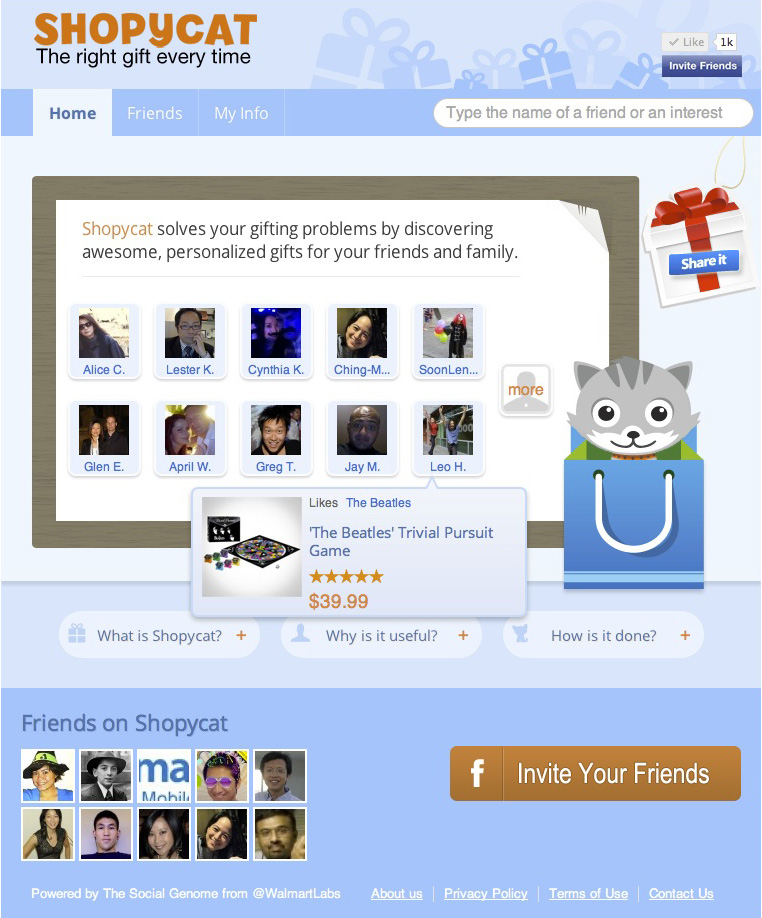
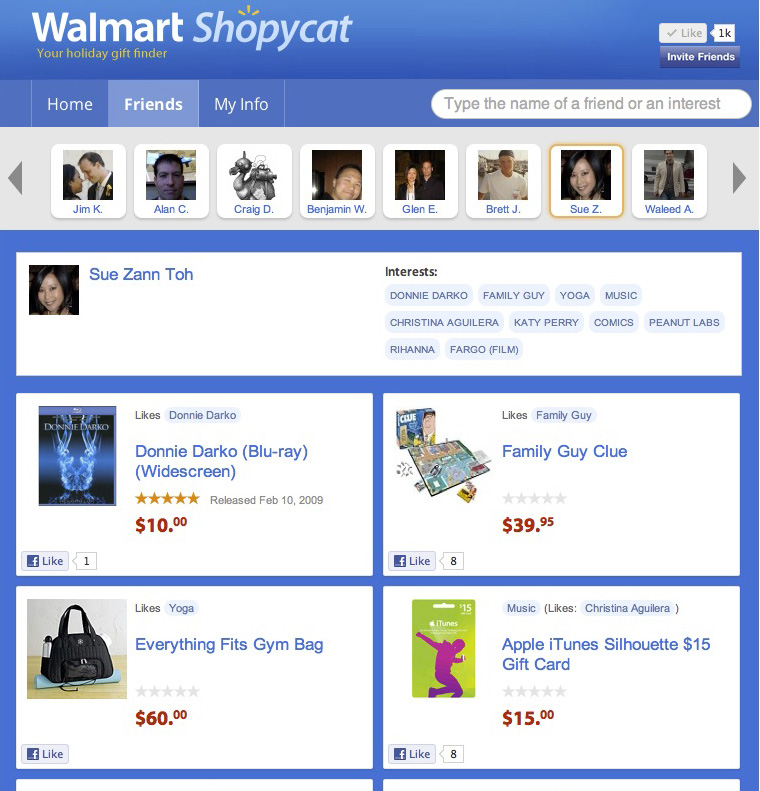
Walmart Launches Shopycat, A Social Gift Finder Built On Top Of Facebook


Shopycat

Retailing giant Walmart is launching its first-ever social gifting platform tonight, dubbed "Shopycat." The service, previously in beta, is initially available as a Facebook application where it will also be promoted to the nearly 11 million Facebook users who have "liked"Walmart's fan page. The app, which suggests gifts for friends based on their Facebook use, was built with technology Walmart acquired from social media startup Kosmix (now @WalmartLabs) earlier this year.

And here's the interesting part: the new app won't just point you to pages on Walmart.com for its gift recommendations. It also recommends products from nearly two dozen other retailers, including Barnes & Noble, ThinkGeek, RedEnvelope, NBC Universal, Hot Topic and more. (Just not, of course, Amazon).

The technology behind Walmart's gift recommendations grew out of Kosmix's Social Genome, a semantic technology platform that was originally used to power social media discovery services built primarily on top of Twitter. Now that Kosmix's platform is a part of Walmart, those same algorithms are used to analyze people's interests based on their Facebook posts, profile updates and "likes."

The system is smart enough to understand the sentiment behind a Facebook status update, too, not just the keywords involved. So, for example, if you posted "I hate Twilight!" as a Facebook status update, Shopycat won't recommend that your friends buy you the "Breaking Dawn" Blu-Ray. It also knows what items are more "giftable" than others, using algorithms that examine a number of signals, including recency, uniqueness (e.g., a collector's edition over a standard edition) and the aggregate buying behavior of shoppers on Walmart.com.

While the obvious goal is to encourage traffic and purchases via Walmart's e-commerce website, the company has taken a unique approach by not making it a Walmart-only application. That is, if Walmart doesn't have the perfect gift in stock, either online or at your local store, it will point you to another retailer who does. For starters, this includes a list of around 20 third parties, but the company plans to increase that number next year. This effort also includes gift cards for things like iTunes, Starbucks and Zynga.

These outside recommendations serve as a clever tactic to boost the viral nature of the Facebook app itself (i.e., it's not Walmart only, so it's actually kind of cool). But the design also helps Walmart take on its main online retailer: the virtually infinite online warehouse that is Amazon. Whether Walmart will then use these referrals (to which it receives no affiliate income, we're told ), to later inform its own buying decisions has yet to be determined.

We do know that the company does plan on integrating Facebook Connect within its own e-commerce site at some point in the future, allowing users to authenticate with Facebook to see social recommendations from friends. This, of course, could serve the even more valuable purpose of associating a Facebook user's online identity with their actual transaction data, but whether or not (or to what extent) this will occur is still unknown.

In the nearer future, the plan is to instead bring the Walmart.com online store to Facebook. The app currently shuffles users out of Facebook when it's time to buy, but by mid-2012, Shopycat will function as an online store itself, allowing users to buy from Walmart without every having to leave Facebook.

Walmart isn't the first to use Facebook's social signals to make gift recommendations, of course. The homemade goods outlet Etsy launched its Gift Finder recently, also on top of Facebook data, and eBay's latest acquisition, Hunch, which is known for building a "taste graph" of recommendations by asking questions, released its own Facebook appback in 2010. However, as the world's largest brick-and-mortar retailer, Walmart's foray into social commerce can't be overlooked.

For what it's worth, Amazon has had similar technology in place since July 2010, and had experimented with Facebook apps for social gifting as far back as 2008. But Amazon's focus lately has been more on mobile, with a plethora apps and its Kindle devices, and less on developing its Facebook recommendation technology. Its Facebook-enabled recommendations, in fact, are still listed as being in "beta" on the Amazon homepage. And frankly, their accuracy hasn't improved much since last year's launch. In early tests, Walmart's Shopycat app seemed at least on par with Amazon's recommendations, which is to say, only fair. (Do not buy me Star Wars Jedi Bath Robes, for example.) But Shopycat doesn't let you customize the recommendations beyond "unliking" a Facebook page to adjust the signals the app uses.

Even though technology like this has existed for years, it's still the early days for social e-commerce. Many of the kinks and problems with leveraging Facebook for recommendations, gifting and otherwise, will be overcome in time. To give Shopycat a go for yourself, visit the Facebook app here.

TIMELINE
Read more >>

“Smart Cities”: Orange desarrolla un sistema asequible para poblaciones pequeñas

Orange ha desarrollado una innovadora aplicación en el ámbito de las "Smart Cities" con el objetivo de que las ciudades pequeñas, con menos capacidad económica que las grandes urbes, también puedan mejorar la gestión de sus recursos mediante el uso de la tecnología, logrando un mayor ahorro de energía y reducción del impacto medioambiental.

La compañía está realizando una prueba piloto del sistema en la localidad catalana de Sant Vicenç dels Horts (municipio de 28.000 habitantes y 9 Km2 de extensión) instalando una red de sensores tolerante al retardo mediante el protocolo de comunicaciones ZigBee. Los sensores utilizados han sido diseñados ad-hoc para vigilancia medioambiental, control de la iluminación, ocupación del alcantarillado y disponibilidad de plazas de aparcamiento que trasmiten la información que recopilan, de forma eficaz y asequible, aprovechando el recorrido de las líneas regulares de autobuses.

En los vehículos se instala un nodo que, a su paso, activa el sensor "dormido" que se haya situado en los espacios en los que debe realizarse una medición. Al activarlo, el dispositivo recupera la información y la transmite a un servidor que es el que almacena, analiza y muestra los resultados para que se puedan tomar decisiones sobre datos reales. La información se transmite al centro de control mediante un enlace M2M (Máquina a Máquina ) mediante tarjetas SIM 3G/GPRS.

Este proyecto impulsado por el Departamento de Innovación de Orange se está realizando con la colaboración de la "Fundació Internet i Innovación Digital de Catalunya " i2CAT, la Universidad Politécnica de Cataluña, y la Concejalía de Tecnologías de la Información del Ayuntamiento de Sant Vicenç dels Horts. Después de un periodo de diseño, pruebas de laboratorio y de campo en la vía pública y en la red de alcantarillado, el servicio estará plenamente operativo durante el próximo mes de enero.

La utilidad de este proyecto y su capacidad de llevar también a las ciudades pequeñas el concepto de sostenibilidad, ha hecho que la prueba piloto desarrollada en la localidad catalana haya sido seleccionada para ser presentada en la "Smart City Expo", el primer evento europeo con un enfoque global sobre ciudades inteligentes que se celebrará en Barcelona del 29 de Noviembre al 2 de Diciembre. El concepto de "smart city" define a aquellas ciudades que aplican soluciones innovadoras para garantizar un desarrollo económico y urbano sostenible en un entorno que ofrezca una buena calidad de vida para sus ciudadanos.

http://www.smartcityexpo.com

LOriginal Page: http://www.eleconomista.es/CanalPDA/2011/13068/

Read more >>

How People Look at Your Facebook Profile and others

The study used the webcams of 30 participants to record their eye movements as they were shown profile pages from Facebook, Google+, LinkedIn, Flickr, YouTube, Klout, Reddit, Digg, Tumblr, Twitter, StumbleUpon and Pinterest at 10-second intervals. What participants looked at on each page and in what order is recorded in the images below.

It's not a perfect study. Thirty is a small sample size, and what draws attention on a profile likely varies depending on the content displayed. But we've hazarded making a few observations:

  • Profile pictures matter. The site feature that attracted most attention on Klout, Facebook and StumbleUpon was the profile photo.
  • Job title garnered more attention than profile photo on LinkedIn. In fact, it got more attention than anything else on the page.
  • Who you know gets noticed. Even if for no better reason than their placement on the page, people do look at those little thumbnails of friends that appear on many social profiles. You can see this in the data from the Facebook, Google+, Twitter and Klout profiles.
  • Content on top wins. The further something is down a page, the fewer number of people look at it. This was true on both content-focused profiles such as Pinterest and Digg as well as socially focused profiles such as Facebook. On the Twitter and YouTube profiles, the effect was less extreme.

Original Page: http://mashable.com/2011/11/30/social-profile-eye-tracking/

Read more >>

miércoles, 30 de noviembre de 2011

3 Steps to Mastering Good Blogger Outreach

3 Steps to Mastering Good Blogger Outreach

Awareness is the first step of any customer outreach program. It has to be, and that's why small business owners are always on the hunt for media coverage. You want to get your name out there to let people know who you are, what you do, and why they should give your company a shot. And when we're talking about getting press as an SMB, it's important to remember that we're not just talking about your local newspapers, local television stations or even the local sections of larger news outlets. We're also talking about bloggers – the voices who cover your industry and/or neighborhood online on a regular basis.

If you're not sure why blogger outreach should be part of your marketing strategy, the recent State of the Blogosphere 2011 report released by Technorati (and blogged about by eMarketer) does a good job laying it all out for you.

  • 38 percent of all bloggers post about brands they love or hate.
  • 34 percent of bloggers write product or service reviews.
  • More than 45 percent of bloggers write about the brands that they follow in social media.

If people are talking about you, people with established audiences, isn't that a conversation you at least want to be in on, if not help lead? Many of these numbers are also up dramatically from just last year. For example, last year's Technorati "State of the Blogosphere" reported that 29 percent of bloggers were influenced by other blogs they read. In 2011, that number has risen to 68 percent. As consumers adopt social buying behaviors, researching online and buying off, more and more they're looking toward online reviews to help them make buying decisions and decide where they want to spend their money. And those online reviews are happening not only on sites like Yelp or TripAdvisor, but also on niche blogs.

As a small business owner, what should you be doing to up your blogger outreach efforts? Below are three steps to get you started.

Step 1: Research Your Contacts

Before you can begin any type of blogger outreach campaign, you have to know who you want to reach out to. Create  a press or media list to help you group and organize your contacts. Your press list should include bloggers who have covered your business in the past, have covered competitors, or cover local happenings or news in your particular industry. To help you track down these people, you can use tools like Twellow or Twitter's Advanced search to find bloggers located in your area, Tweepz to search Twitter bios for relevant keywords, Twitter directories like WeFollow, and your social analytics to identify which fans of your brand are tweeting or talking about you naturally. Your press list should be built out to include the blogger's name, the blog URL, their social handles, an email address, the angle they typically cover, etc.

Step 2: Get on Their Radar

Once you have a blogger in your sights, it's time to start a relationship. Just like at a cocktail party, you never want someone's first contact with your brand to be you asking them for a favor or a handout. Make it about them as you lay the groundwork for a  relationship. Get on their radar by starting a conversation on Twitter, helping them promote something they just published, sending them an email to say you're enjoying their content (without pitching yours!) or connecting with them on Facebook. Just do something to get that conversation flowing and help them remember your name. That name recognition is what you're going for to help you go from "stranger" to "friend."

Step 3: Master the "Unpitch"

No one likes to be marketed to, but we all like finding out about great new products or services. As bloggers, we also like being the first to share that information with our audience. When you do reach out to your blogger contacts about covering your company, reviewing your product, or just sharing what you do with their audience, help it sound less like a pitch by highly customizing it to the person you're talking to. An email telling someone about a new product isn't marketing when it's something that is very relevant to them or their audience. Then it becomes a useful heads-up and something we can use. Master the "unpitch" by matching your message directly to the needs of the person you're contacting and showing the benefits of your product instead of trying to sell them. It's OK to ask for a product review or ask to be included in an upcoming post, but make sure you tell them what's in it for them and their audience , not for you.

As social buying patterns continue to grow in influence, consumers will continue to seek out information about others' interactions with brands. And when they do, it's blogs that they'll stumble upon. What are you doing to better connect your brand with the writers providing that information and the people looking for it?

From Small Business Trends

3 Steps to Mastering Good Blogger Outreach

Read more >>

Códigos QR: cualquier campaña, cualquier mercado y cualquier canal

Códigos QR: cualquier campaña, cualquier mercado y cualquier canal

Presentes en las marquesinas, en los periódicos, en los alimentos envasados.  Presentes también, en los catálogos de venta de productos, en los sitios Web y cada vez más… parte de nuestras vidas, hablamos de los Códigos QR.

Acercando el marketing a la experiencia del usuario

Su crecimiento y penetración en nuestros hábitos y costumbres está íntimamente ligado al auge de la Web móvil y sus aplicaciones se centran cada vez más en dotar de un valor agregado a las estrategias de marketing.

La toma de conciencia sobre la eficiencia de los códigos QR aplicados a la publicidad y la mercadotecnia es muy poderosa principalmente, porque son los consumidores quienes encuentran en ésta nueva funcionalidad, un aliado de sus comparativas, análisis y decisiones de compra.

Crecimiento exponencial que habla de tendencias

Según un informe elaborado por Nellymoser el auge de los códigos QR ha sido durante el ejercicio 2011 superior al ¡228%! En Estados Unidos.
No cabe duda que el tándem conformado por la publicidad y los Códigos QR está suponiendo una revolución para el marketing.

¿Cómo funcionan?

Los códigos QR se leen a través de los dispositivos móviles o Internet con una aplicación aunque se descarga gratis. A partir de la captura de la imagen, el programa enlaza a un sitio Web donde se visualiza la información que contienen.

¿Podemos imaginar la cantidad de usos o aplicaciones que podemos darle a esta funcionalidad?

  •  Estudios de mercado
  •  Nuevos productos
  •  Tiendas virtuales
  •  Promociones
  •  Sorteos
  •  Contenido
  •  Educación

Y así un largo etcétera que hace de los Códigos QR  un gran aliado de las campañas de nuestra empresa.

La importancia del contenido, destino final de los QR

Es esencial tener en cuenta que,  si bien son cada vez más frecuentes, su utilización como parte de una estrategia publicitaria aún es visto como un elemento que aumenta el valor añadido de nuestra campaña… ¿por qué?

No debemos  olvidar que los Códigos QR derivan al contenido generado por la marca, no es sino a través de la entrega de un contenido que responda a las necesidades reales de nuestro público objetivo.

En resumen…

Los usuarios tienen la posibilidad de conocer nuestros contenidos, interactuar socialmente, acceder más fácilmente a la culminación del proceso de compras, descargar e-books o Newsletter, obtener todo tipo de información de relevancia de la empresa y/o sus productos.

Las marcas por su parte, encuentran en los QR grandes una mejor posibilidad de interactuar con sus aliados y entregar contenidos que respondan a las necesidades "reales" de los consumidores, logrando el tan ansiado objetivo de la "experiencia del usuario".

Códigos QR, educación y publicidad ubicua

Los códigos QR nos permiten el acceso a la información necesaria para interactuar con nuestras marcas, ello nos habla de un poderoso aliado de la educación y formación constante que ha permitido la toma de poder de un consumidor cada vez más preparado, conectado y exigente.

De igual forma, los Códigos QR nos permiten dar un paso más en la consolidación de la nueva pauta publicitaria,  centrada en la optimización de la ubicuidad,  que nos permite actuar como una sola voz en un entramado multicanal.

Cualquier campaña, cualquier mercado y a través de cualquier medio… ¿eficiente verdad?

 Fuente : socialmediaempresario.com/codigos-qr-cualquier-campana-cualquier-mercado-y-cualquier-canal

Read more >>

martes, 29 de noviembre de 2011

LocalVox Launches Full-Service Marketing Solution To Help Local Merchants Target Their Customers

LocalVox Launches Full-Service Marketing Solution To Help Local Merchants Target Their Customers

139187v2-max-250x250

Hyperlocal is all the rage these days, and content companies, deal sites, and everyone in between are trying to find better ways to access (and advertise to) local markets. Over the last decade, the majority of media companies have attempted to launch internal or on-site outlets that cover local news, but most have met with middling success.

NearSay, a New York City-based startup that launched six months ago, began by asking a simple question: "Where do we get our neighborhood news?" NearSay's founders, Trevor Sumner and David Pachter, were startled by the lackluster and confusing responses to that question and, in turn, the dearth of valuable neighborhood outlets for local news. So, for their answer, they started a platform that began as a realtime business newswire to allow local businesses in New York City to publish announcements (on events, deals, etc.) to the NearSay platform.

Now an aggressive publisher of neighborhood lifestyle news, the startup has partnered with small, local publications (where they exist) to allow local businesses to target their content to the people who can actually benefit from — and want to hear about — local news. To add to their platform, the startup launched LocalVox, which is (among other things) a white label advertorial publishing tool that allows niche publishers to syndicate their clients' content across the startup's network and blast that content out to social media outlets.

The idea was to create a Yellow Pages 3.0, which not only serves as a tool to help readers or searchers find telephone numbers or addresses of local merchants, but to actually help those merchants optimize their placement in search results and get found by the people who need them.

Today, the company is now calling itself LocalVox Media, and NearSay, its contextual newswire service, has become a feature of the platform. As a part of this rebranding, the startup is launching LocalVox 2.0, with which it is hoping to become a full, multichannel marketing tool for local businesses and publishers. The white label tool it launched initially was aimed at larger publishers which already had sales and customer service teams, but Version 2.0 makes the company a full-service solution for all publishers and local businesses.

To date, the platform has attracted 270 clients which are using the service to publish company events, promotions, and community programs through NearSay's network; so, with LocalVox 2.0, the startup is looking to become a full-service tool for its clients by integrating Google Local optimization and social media management services.

Leveraging Google Places and Google Plus, social media, email marketing and more to create a simple way for their clients to generate news and target new and existing customers, LocalVox wants to enable community businesses to attain optimized Google placements — all through an all-in-one marketing solution characterized by a user-friendly interface. This last bit has become increasingly important, as local marketing solutions are realizing that products that sound technical or rely too heavily on self-service models are failing to see the adoption among small merchants that many hoped they would have.

Thus, LocalVox sees itself as a long-term marketing partner for its clients, not a quick fix. So, in contrast with Groupon's model, which creates episodic bursts of activity and exposure for small businesses, LocalVox provides a searchable history of news content that lives on each business' web page that is optimized for search engine placement and social media integration — all of which is intended to create additional exposure over time.

Or looking at LocalVox in juxtaposition with Aol's hyperlocal news outlet Patch, for example, LocalVox sees its value not as a destination site, but in leveraging programs that engage consumers across multiple channels and take the pain of managing search engine placement, social media, and multichannel marketing strategies out of the hands of the merchants themselves.

What's more, local businesses often find difficulties in updating and maintaining their websites with relevant content, and making their sites into workable, valuable communication platforms. So LocalVox wants to help them, say, upload customer lists and avoid going to a third-party source to upload a newsletter.

According to LocalVox Co-founder Trevor Sumner, it's this approach that has led the startup to a 95 percent retention rate among participating businesses — compared to Groupon's retention rate at 18 percent.

To date, the startup has raised a small angel round, but it is in the process of raising a series A round, Sumner says. Currently, LocalVox is only available in New York City, but the startup plans to expand into new markets beginning in early 2012.

And, for TechCrunch readers interested in testing LocalVox 2.0, the company is offering five local NYC businesses a free month of social media strategy and implementation as well as a free month of Google Places optimization. The startup will select the businesses from those who send emails to LocalSales@LocalVox.com with "TechCrunch" in the subject line.

Original Page: http://feedproxy.google.com/~r/Techcrunch/~3/UbjMg92e_os/

Read more >>

Who to Follow on Twitter for Innovative Business Ideas - Blog

Five to Follow 

Who to Follow on Twitter for Innovative Business Ideas

Mario Schulzke believes in the power of ideas.

But the German-born ad agency director and part-time Ironman triathlete isn't just keen on his own musings, Schulzke wants to help you enliven your own innovative ideas too. Enter, IdeaMensch, the Los Angeles-based website that features daily interviews with visionaries, CEOs and entrepreneurs.

How does he crystalize these concepts? Twitter, for one @ideamensch. Here are Schulzke's top five Twitter streams to follow for finding the best new entrepreneurial ideas.

  1. @trendwatching
    Followers: 53,339
    Tweets: 1,530
    Operating out of London with hundreds of "spotters" worldwide and 160,000 subscribers Trendwatching.com is on the hunt for the latest fads. The research firm's Twitter feed, as one would expect, is primarily comprised of previews of trends from around the globe.
    Sample tweet: Crearmoda - In Spain, design your own clothing via 3D simulatorhttp://www.springwise.com/fashion_beauty/spain-design-clothing-3d-simulator/ ( #MIY )
     
  2. @springwise
    Followers: 37,811

    Tweets: 2,631
    Also from London, Springwise.com posts about entrepreneurial ideas from around the world, such as customizable liqueurs in the U.K. and smartphone grocery shopping in South Korea. Through its blog, newsletter and Twitter feed, Springwise dispatches trend reports and profiles about small businesses and entrepreneurs. 
    Sample tweet: Marriott's Renaissance Pittsburgh Hotel — Guests surrender digital devices upon check-in
     
  3. @psfk
    Followers: 35,870

    Tweets: 22,234
    Self-described as, "Your go-to source of new idea tweets," the New York publisher and consultancy, PSFK has one primary belief: All innovative ideas are worth sharing. What does the company tend to tweet? Ideas, ideas, ideas. No matter how big — or little — the goal is to share knowledge in the hopes that innovation begets more innovation.
    Sample tweet: New Heat Imaging Technology Makes Tanks Invisible
     
  4. @kickstarter 
    Followers: 441,884
    Tweets: 1,718
    Since you're likely not the only one with a peerless creative project in mind, consider going to the source of where projects get funded. One popular stop is the New York-based funding platform, Kickstarter.com. The company's tweets tend to revolve around boosting the awareness of projects hoping to obtain funding on the site. 
    Sample tweet: Project of the Day: Aron Steinke's autobiographical comic featuring his wolf-monster doppelgänger.
     
  5. @coolhunting
    Followers: 75,130
    Tweets: 4,235
    Coolhunting.com knows what cool is. Art, style, culture, technology — you name it and this New York-based publication is featuring it on their exhaustive website. Coolhunting.com's Twitter feed features daily updates on innovative products and services.
    Sample Tweet: The future arrives in the present with a charity auction of 1500 pairs of long-coveted sneakers http://bit.ly/nEkwjC

Original Page: http://www.entrepreneur.com/blog/220790

Read more >>

lunes, 28 de noviembre de 2011

How Blogging Can Generate Income

Owning a successful blog these days means that you have to make a living with it. You might have the largest readership for your blog. But, if you are not using it to get cash, then you are not utilizing it to your benefit. If you asked around, you will find out that even the most visited blogs are not doing well when it comes to earning an income. They are not trying to find ways to take the earning power that they have in their blogs and use it to their advantage. Unless you are only doing it as a hobby, then you do not have a reason to not concentrate on making money with your blog.

Given below are three effective tips that will help you understand how you too can go about monetizing your blog effectively. live tv on the pc is an area that is just loaded with helpful details, as you just have read. One thing we tend to believe you will discover is the right info you need will take its cues from your current predicament. There are always some things that will have more of an effect than others. Exactly how they effect what you do is something you need to carefully consider. Here are several more equally important highlights on this important topic.

First, sign up for a few affiliate programs that are related to your blog's topic. This is so that you can promote affiliate products on your blog. When it comes to placing affiliate links on your blog, there are huge amounts of affiliate programs available on the internet. You have your choice of cpc or cpa affiliate programs. This will rely on your personal preference. If you ask around, you will find out that bloggers used affiliate programs all the time to earn a living with their blogs. The most important benefit of signing up for affiliate programs is that you can begin making money with them from day one.

Promoting post sponsorships is another way that is proven to work really well. But, not all bloggers really like doing this. However, if you do not see anything wrong with it, then see if it works for you. It is all about getting paid for putting sponsored posts on your personal blog. This is when the product is seen just because of your blog.

This is not the same as sponsored reviews, where all of the post is advertiser funded.

You can probably use your blog as a way to give your customers a service for a fee. Besides, you blog will do a lot to get your readers to see you as an authority who is credible. Use all of this to your advantage in order to sell your services to your readers for a fee. Pretend that blog is about internet marketing. Consider starting a SEO company that helps other companies to get good search engine rankings.

A decent income is possible with your blog, but you have to start giving it a solid foundation now. This is when you need to start taking the right steps to create a long term cash flow from your blog. If you already have a good foundation of readers, then you can choose a method that works with your target audience so you don't lose them. This article is just the basic foundation of what is available to learn. The thing about it is that the average person is way too consumed and does not have time to know all there is about work from home data entry. This is just like many other areas in which you can have a true edge when you have the right kind of information. It truly does not have to be torture to get the best available knowledge, and when you do then you will realize what we mean.

Read more >>

domingo, 27 de noviembre de 2011

El marketing online aumenta la rentabilidad de las empresas


El marketing online quizá no sea una estrategia tan útil como se pensaba para la captación de nuevos clientes, pero los que se consiguen son mucho más rentables de lo que se logran por otras vías.

Al menos esto es lo que se deduce de un estudio reciente publicado por Hinge Research Institute, que llegó a las siguientes conclusiones:

"Las empresas generadoras del 60% o más de sus clientes potenciales online son 2 veces más rentables que las que generan menos del 20% de sus clientes potenciales online."

La principal razón para este aumento en la rentabilidad es que el marketing online tiene un coste mucho menor para las empresas, mientras que las ganancias por cada cliente siguen siendo las mismas.

Según el mismo estudio, las técnicas que dan mejores resultados son los ebooks y otros documentos técnicos, los blogs y el posicionamiento web.

Por el contrario, los banners, el pago por clic y los canales en Youtube son las estrategias menos eficaces.

Los motivos para esto pueden ser que en los banners y los vídeos muchos usuarios clican por simple curiosidad, sin intenciones reales de realizar ninguna compra o contratación de servicios.

Por lo tanto, aquellas empresas que se estén planteando realizar un cambio en su estrategia de marketing quizá deberían plantearse aumentar la partida dedicada al marketing online, ya que suele llegar realmente a los clientes potenciales que puedan tener un mayor interés en nuestros productos y servicios. Además, un blog o una cuenta en redes sociales puede darnos muy buenos resultados sin necesidad de unos costes demasiado altos..


Original Page: http://www.ojointernet.com/noticias/el-marketing-online-aumenta-la-rentabilidad-de-las-empresas/


Read more >>

How to Make Your Startup Go Viral The Pinterest Way


pinterest.com_uv_1y 

On Thanksgiving, Pinterest's co-founder Ben Silbermann sent an email to his entire user base saying thanks. It was fitting, as Pinterest was born two years ago on Thanksgiving day 2009.  Ben had been working on a website with a few friends, and his girlfriend came up with the name while they were watching TV. Pinterest officially launched to the world 4 months later.

Some startups go crazy with hype and users right after launch. And some don't. I don't know the founders, but I thought I'd take apart Pinterest's story to discuss growth and virality in consumer web startups. Pinterest was not an overnight success. On the contrary, its growth was surprisingly modest after Turkey Day 2009.

Take a look at Pinterest's one-year traffic on Compete from Oct 2010 to Oct 2011, which is the picture in this post, and shows Pinterest rising from 40,000 to 3.2 million monthly unique visitors. I took both ends of this chart and estimated monthly compounded growth over Pinterest's lifetime, then interpolated the curve using constant growth and put the results in this Google Spreadsheet.

Backing out of Compete's numbers, we see Pinterest grew about 50% month over month from a base of zero since its inception (on average, smoothing the curve). Today growth is catching fire, as evidenced by the near doubling of traffic last month, and Pinterest's page views growing 20X since June, according to comScore.

Note these numbers are approximations and also do not count the significant traffic the service sees from mobile (Pinterest's app currently takes the #6 social spot in the iTunes store). Also my guess is that a lot of its unique visitors arrive out of network (from Facebook / Twitter), and many of these uniques leave Pinterest without registering (more on this below) so it's tough to know their exact user numbers.

But let's play pretend and use the data we have to do some projections on where Pinterest could be a year from today.  Its recent VCs certainly did this, and decided to give the startup a $200M+ valuation.  Ron Conway said recently that Pinterest is growing like Facebook did in 2006. Facebook actually grew from 14 million uniques to 26 million uniques from May 2006 to May 2007, then a year and half later they had rocketed to 140 million uniques, and were growing at about 20 million uniques per month. So monthly growth early on for Facebook was around 10-15%.

Can Pinterest really sustain its wild 45% monthly growth? No, unless it's destined to be the fastest growing startup in history. However, we can be pretty sure Pinterest has hit a tipping point… their page view numbers are simply insane. If they were to grow 20% month/month over the next year, Pinterest would be at 30 million uniques a year from today. And with 25% month/month growth, they'd be at 50 million.  These are pure guesses, but Ron's statements and last month's growth make this look possible, so let's examine virality and Pinterest's underlying fundamentals.

Virality – Does My Startup Really Need It?

Viral sharing is typically emphasized in products or services where the cost to acquire a customer needs to be low, and you can't afford to spend money on paid channels, like Mint.com did, or like a Living Social / Groupon.  Having a free method, ideally a user-driven method, is critical to consumer web startups.

But there's a lot of confusion around virality. The reality is that you can build a sustainable business without "going viral" and this point is not understood well among techies or investors. The connotation "going viral" typically means having a viral growth coefficient of greater than 1. For every user that comes on your platform, he or she refers 1 additional user. This ensures a service will "hockey stick".

But what if every user only refers, say 0.2 new users? Contrary to popular belief, this can also lead to a sustainable business. However, the lack of pure virality implies that you absolutely must retain existing users to grow. This is why daily active users and monthly active users are such important metrics, and are tracked maniacally by CEOs and investors. Churn is your ultimate enemy. Sure, it will take longer to grow if each user brings in fewer new people, but as long as most users don't leave, you're all good.

Viral cycle times also factor in – the shorter the "referrer" period, the faster the virality takes hold – for example, if a user invites 1 new user every month, that's better than if she invites 1 per year. Social games like Zynga historically have extremely short viral cycles; however they must, because churn is extremely high (user lifetime is often measured in hours or days, because users get bored with games quickly and move on).

Obviously, the more viral a service, the more sustainable it is, but it's really in the details. And overnight success is not a guarantee for sustainability. Many startups are pushing way too prematurely on press before they've demonstrated real sustainability. I see this all the time and Eric Ries covered this in his discussion on the danger of vanity metrics.

The truth is that startups often draft off of artificial success that originates simply from hype within the tech echo-chamber. Some sites go from 0 to 100K+ visitors in weeks and people high five one other, then look around and say "what's next,  how do we keep these users happy?"

Pinterest's Virality and Sharing Examined

Pinterest's story is much different – they didn't have the same early "hype spikes" as many other startups do, standing at only 40K uniques 8 months after launch! It took Pinterest quite a while for a network-effect to take hold. Clearly every startup should hope for early virality. But if it doesn't exist initially, you must work to perfect a soft onboarding of virality that's based on high engagement, and create a product that people love and will come back to, while layering viral techniques on top of that.

Today, Pinterest is clearly insanely addictive among its user base, and they are sharing.  But one reason I see Pinterest as a valuable a case study is precisely because they didn't experience the early adopter "hype" spike 18 months ago. Like many tech startups, I am sure some content was seeded within the tech community by the founders. But their "normal" user was a housewife in the Midwest, not a techie reading TechCrunch or Hacker News. And I'm sure Pinterest made a bunch of product tweaks early on to iterate around sharing and engagement, as virality took hold.

Let's compare Pinterest to Instagram for a minute, since both base off of photo content as their primary unit. Instagram has actually done nearly all its user acquisition virally out of network (sharing to Facebook and Twitter) and via word of mouth, with limited sharing in the network. This is remarkable when you think about it.  By that I mean that there's no real sharing inside the network other than liked photos surfacing due to popularity, and manual discovery via hashtags. There is no "regram" if you will. You also can't follow people or like a photo from Instagram without an iPhone (even if it's tweeted or posted to the web!) unless you're a power user on an API mashup (see Inkstagram). All this reveals just how impressive Instagram's growth has been, as they went from about 1 million to 10 million users over the past year.

Being realistic, Pinterest could have much higher growth than Instagram based on the fact that it's unconstrained as a platform – it works from web, mobile web, in-app, and has easier baked-in virality around sharing. "Pinning" has this built in because many initial pins start as "repins" of other people's content. In this way, existing content will often be the seed for a new user's stream. The pin unit is genius.

Users can also visit the Pinterest site and participate (i.e. browse endlessly) before signing up. This allows full consumptive access before registering and is a secret weapon if done right. Fred Wilson discussed this recently in his post about the logged out user, giving an example of his mom checking his tweet stream without logging into Twitter – she gets value out of the service while ironically bringing down Twitter's monthly active user metric. Similar value can be granted to consumptive users who visit the site but don't initially register.

Then when a user is ready to pin content, they create an account and go wild – Pinterest leverages web content from Tumblr like no site that has ever existed, thus riding on top of its network-effect while not requiring user generated content like many services. They've also perfected in-network virality (pin, repin, like) in addition to out of network sharing (Facebook, Twitter) to grow virally. For these reasons Pinterest could conceivably grow as fast as any consumer service we have seen in recent memory. It's fun to speculate on all this when you factor in Ron Conway's statements comparing growth to Facebook's early heydays.

And perhaps most notably, though it will surely take a while, Pinterest is already threatening to monetize, as those Midwest housewives are literally using it for shopping discovery, which Pinterest can profit off of by taking attribution for purchases that originate off its platform. I know several friends who've purchased stuff spontaneously via random discovery on the site. I expect Pinterest to be thriving a year from now (my guess is 30 million users next Thanksgiving) and also spawn hundreds of copycat startups in other verticals ("Pinterest for that"). Sadly, many of these will arrive on TechCrunch and spike in hype, then fail to nail any true virality before they are slowly forgotten… After all, this is the cycle of consumer startups.

Read more >>